

Who Repairs Antique Radios Near 18944
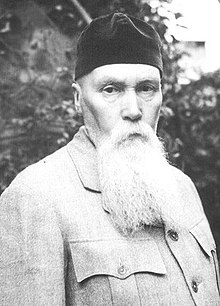
| Nicholas Roerich | |
|---|---|
 | |
| Born | (1874-10-09)October 9, 1874 Saint petersburg, Russian Empire |
| Died | December 13, 1947(1947-12-13) (aged 73) Naggar, Dominion of Bharat |
| Nationality | Indian |
| Occupation | painter, archaeologist, costume and set designer for ballets, operas, and dramas |
| Spouse(s) | Helena Roerich |
| Children | George de Roerich, Svetoslav Roerich |
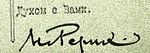
| Signature | |
 | |
Nicholas Roerich (; October 9, 1874 – December 13, 1947), besides known as well equally Nikolai Konstantinovich Rerikh (Russian: Никола́й Константи́нович Ре́рих), was a Russian painter, author, archaeologist, theosophist, philosopher, and public figure. In his youth was influenced by Russian Symbolism, a motion in Russian order centered on the spiritual. He was interested in hypnosis and other spiritual practices and his paintings are said to have hypnotic expression.[1] [ii]
Born in St. petersburg, to a well-to-do notary public Baltic German father and to a Russian mother,[3] Roerich lived in various places in the world until his death in Naggar,[4] Himachal Pradesh, Bharat. Trained as an artist and a lawyer, his master interests were literature, philosophy, archaeology, and especially art. Roerich was a dedicated activist for the cause of preserving art and architecture during times of war. He was nominated several times to the longlist for the Nobel Peace Prize.[5] The so-called Roerich Pact was signed into law by the United States and nigh other nations of the Pan-American Wedlock in April 1935.
Biography [edit]
Early life [edit]
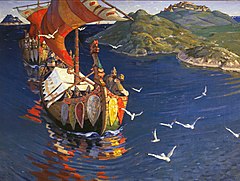
Raised in late-19th-century St. petersburg, Roerich enrolled simultaneously at St. Petersburg Academy and the Imperial University of Arts in 1893. He received the title of "artist" in 1897 and a degree in police force the next year. He found early employment with the Imperial Society for the Encouragement of the Arts, whose school he directed from 1906 to 1917. Despite early tensions with the group, he became a member of Sergei Diaghilev's "Earth of Art" lodge and was its president from 1910 to 1916.
Artistically, Roerich became known every bit his generation'southward about talented painter of Russia's ancient by, a topic that was compatible with his lifelong interest in archæology. He also succeeded as a phase designer by achieving his greatest fame as one of the designers for Diaghilev's Ballets Russes. His all-time-known designs were for Alexander Borodin's Prince Igor (1909 and later on productions), and costumes and set for The Rite of Spring (1913),[6] composed by Igor Stravinsky.
Along with Mikhail Vrubel and Mikhail Nesterov, Roerich is considered a major representative of Russian Symbolism in art.[7] From an early menstruation of his life, he was influenced by apocrypha and medieval sectarian writings such equally the mysterious Pigeon Book.[8]
Some other of Roerich's creative subjects was architecture. His acclaimed publication "Architectural Studies" (1904–1905), consisting of dozens of paintings he made of fortresses, monasteries, churches, and other monuments during two long trips through Russia, inspired his decades-long career every bit an activist on behalf of artistic and architectural preservation. He too designed religious fine art for places of worship throughout Russia and Ukraine, near notably the Queen of Sky fresco for the Church of the Holy Spirit, which the patroness Maria Tenisheva built near her Talashkino estate, and the stained drinking glass windows for the Datsan Gunzechoinei in 1913–1915. His designs for the Talashkino church building were so radical that the Orthodox church building refused to consecrate the building.[7]
During the first decade of the 1900s and in the early 1910s, Roerich, largely by the influence of his married woman, Helena, developed an interest in eastern religions, also as culling (to Christianity) conventionalities systems such every bit Theosophy. Both Roerichs became avid readers of the Vedantist essays of Ramakrishna and Vivekananda, the poesy of Rabindranath Tagore, and the Bhagavad Gita.
The Roerichs' delivery to occult mysticism increased steadily. Information technology was particularly intense during World War I and the 1917 Russian Revolution to which the couple, like other many Russian intellectuals, accorded apocalyptic significance.[9] The influence of Theosophy, Vedanta, Buddhism, and other mystical topics can be detected not only in many of Roerich's paintings but also in the many brusk stories and poems that Roerich wrote before and after the 1917 revolutions, including the Flowers of Morya cycle, which was begun in 1907 and completed in 1921.
Revolution and emigration to Usa [edit]
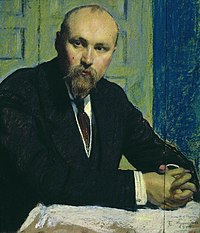
Later the February Revolution of 1917 and the stop of the czarist regime, Roerich, a political moderate who valued Russia's cultural heritage more than ideology and party politics, had an agile function in creative politics. With Maxim Gorky and Aleksandr Benois, he participated with the and then-called "Gorky Commission" and its successor organization, the Arts Union (SDI). Both attempted to proceeds the attention of the Provisional Government and Petrograd Soviet on the demand to grade a coherent cultural policy and, virtually urgently, to protect art and architecture from destruction and vandalism.
Meanwhile, illness forced Roerich to get out the capital and reside in Karelia, the commune adjoining Finland. He had already quit the presidency of the World of Art society, and he now quit the directorship of the Schoolhouse of the Imperial Society for the Encouragement of the Arts. After the Oct Revolution and the acquisition of power of Lenin's Bolshevik Party, Roerich became increasingly discouraged about Russia's political time to come. During early 1918, he, Helena, and their two sons George and Svetoslav emigrated to Republic of finland.
Ii unresolved historical debates are associated with Roerich's difference. Get-go, information technology is often claimed that Roerich was a major candidate to direct a people'southward commissariat of culture (the Soviet equivalent of a ministry of culture), which the Bolsheviks considered establishing in 1917–1918, but he refused to accept the job. In fact, Benois was the near likely option to direct any such commissariat. It seems that Roerich was a preferred choice to manage its department of artistic education; the topic is rendered moot past the fact that the Soviets elected not to establish such a commissariat.
Second, when Roerich after wished to reconcile with the Soviet Marriage, he maintained that he had non left Soviet Russian federation deliberately, only that he and his family, living in Karelia, had been isolated from their homeland when the Finnish Civil War began. However, Roerich had an amply-documented extreme hostility to the Bolshevik government, prompted not so much by a dislike of communism as by his revulsion at Lenin'southward ruthlessness and his fearfulness that Bolshevism would effect in the destruction of Russia's creative and architectural heritage. He illustrated Leonid Andreyev's anticommunist polemic "S.O.Southward." and had a widely-published pamphlet, "Violators of Art" (1918–1919). Roerich believed that "the triumph of Russian culture would come about through a new appreciation of ancient myth and legend."[10]
Later on some months in Finland and Scandinavia, the Roerichs relocated to London, arriving in mid-1919. Engrossed with Theosophical mysticism, they now had millenarian expectations that a new age was imminent, and they wished to travel to Bharat equally before long every bit possible. They joined the English-Welsh chapter of the Theosophical Club. It was in London, in March 1920, that the Roerichs founded their own school of mysticism, Agni Yoga, which they referred to also as "the system of living ethics."
To earn passage to India, Roerich worked equally a stage designer for Thomas Beecham's Covent Garden Theatre, only the enterprise ended unsuccessfully in 1920, and the artist never received total payment for his piece of work. Among the notable people Roerich befriended while in England were the famed British Buddhist Christmas Humphreys, the philosopher-author H. Thousand. Wells, and the poet and Nobel laureate Rabindranath Tagore (whose k-niece Devika Rani would later marry Roerich's son Svetoslav).
A successful exhibition in London resulted in an invitation from a director at the Art Constitute of Chicago, offering to arrange for Roerich's art to tour the United states of america. In the autumn of 1920, the Roerichs traveled to America by sea.

Car of Nicolas Roerich in his museum at Naggar
The Roerichs remained in the Us from Oct 1920 until May 1923. A large exhibition of Roerich'due south art, organized partly by the U.Southward. impresario Christian Brinton and partly by the Chicago Art Institute, began in New York in December 1920 and toured the state, to San Francisco and back, in 1921 and early 1922. Roerich befriended acclaimed soprano Mary Garden of the Chicago Opera and received a committee to blueprint a 1922 production of Rimsky-Korsakov'southward The Snow Maiden for her. During the exhibition, the Roerichs spent significant amounts of time in Chicago, New Mexico, and California.
Politically, Roerich was at beginning anti-Bolshevik. He gave lectures and wrote articles to White Russian populations in which he criticized the Soviet Union. Withal, his disfavor to communism, "the impertinent monster that lies to humanity," changed in America. Roerich claimed that his spiritual masters, the "Mahatmas" in the Himalayas, were communicating telepathically with him through his wife, Helena, who was a mystic and a clairvoyant.
The beings from an esoteric Buddhist customs in India were said to have told Roerich that Russia was destined for a mission on Earth. That led him to codify his "Smashing Plan," which envisaged the unification of millions of Asian peoples through a religious motility using the Futurity Buddha, or Maitreya, into a "2d Union of the Eastward." In that location, the King of Shambhala would, following the Maitreya prophecies, make his appearance to fight a great battle against all evil forces on Globe. Roerich understood that every bit "perfection towards Common Expert." The new polity was to include southwestern Altai, Tuva, Buryatia, Outer and Inner Mongolia, Xinjiang and Tibet, with its capital in "Zvenigorod," the "City of Tolling Bells," which was to be built at the human foot of Mount Belukha, in Altai. Co-ordinate to Roerich, the same Mahatmas revealed to him in 1922 that he was an incarnation of the Fifth Dalai Lama.[11]
In 1923, Roerich, the "practical idealist," set up out to the Himalayas with his wife and his son Yuri. Roerich initially settled in Darjeeling in the aforementioned firm that the 13th Dalai Lama had stayed during his exile in India. Roerich spent his fourth dimension painting the Himalayas with visitors such as Frederick Marshman Bailey, Lady Lytton, and members of the 1924 British Everest Expedition, also as Sonam Wangfel Laden La, Kusho Doring, and Tsarong Shape, influential Tibetans. Co-ordinate to British intelligence, lamas from the Moru monastery recognized Roerich as the incarnation of the 5th Dalai Lama due to a mole blueprint on his right cheek. It was during his stay in the Himalayas that Roerich learned about the flight of the 9th Panchen Lama, which he interpreted equally the fulfillment of the Matreiya prophecies and the bringing well-nigh of the Age of Shambhala.[12]
In 1924, the Roerichs returned to the West. On his manner to America, Roerich stopped at the Soviet embassy in Berlin, where he told the local plenipotentiary about a Central Asian expedition he wanted to take. He asked for Soviet protection on his mode, and shared his impressions of politics in Bharat and Tibet. Roerich commented on the "occupation of Tibet by the British" by challenge that they "infiltrate in modest parties... conduct extensive anti-Soviet propaganda" by talking virtually "anti-religious activity of the Bolsheviks." The plenipotentiary later on pointed out to one of Roerich's old university classmates, Georgy Chicherin, that he had "absolutely pro-Soviet leanings, which looked somewhat Buddho-Communistic," and that his son, who spoke 28 Asian languages, helped him in gaining the favor with the Indians and the Tibetans.[13]
The Roerichs settled in New York City, which became the base of their many American operations. They founded several institutions during these years: Cor Ardens ("Flaming Heart") and Corona Mundi ("Crown of the World"), both of which were meant to unite artists around the globe in the cause of civic activism; the Primary Institute of United Arts, an art schoolhouse with a versatile curriculum, and the eventual home of the first Nicholas Roerich Museum; and an American Agni Yoga Lodge. They also joined diverse theosophical societies; their activities with these groups dominated their lives.
Asian expedition (1925–1929) [edit]

Roerich'due south family unit (Kullu valley, India)
Subsequently leaving New York, the Roerichs, together with their son George and half dozen friends began the 5-year Roerich Asian Trek that in Roerich's own words "started from Sikkim through Punjab, Kashmir, Ladakh, the Karakoram Mountains, Khotan, Kashgar, Qara Shar, Urumchi, Irtysh, the Altai Mountains, the Oyrot region of Mongolia, the Central Gobi, Kansu, Tsaidam, and Tibet" with a detour through Siberia to Moscow in 1926.
The Roerichs' Asian expedition attracted attention from the strange services and intelligence agencies of the Soviet Union, the U.s.a., the Uk, and Japan. In fact, prior to this expedition, Roerich had solicited the assistance of the Soviet government and Bolshevik secret constabulary to assist him in his expedition past promising in render to monitor British activities in the surface area, simply he received but a lukewarm response from Mikhail Trilisser, the master of the Soviet foreign intelligence.
The Bolsheviks assisted Roerich with logistics while he was traveling through Siberia and Mongolia. However, they did non commit themselves to his reckless project of the Sacred Union of the Due east, a spiritual utopia that boiled down to Roerich's ambitious attempts to stir the Buddhist masses of inner Asia to create a highly spiritual co-operative commonwealth under the patronage of Bolshevik Russian federation.
The official mission of his expedition, as Roerich put it, was to act as the embassy of Western Buddhism to Tibet. To the Western media, it was presented as an artistic and scientific enterprise.[xiv] Roerich reported seeing a metallic oval in the sky over the Tibet; Decades subsequently, UFO enthusiasts would merits the Roerich expedition witnessed a "flight saucer".[15] [16]
Between the summer of 1927 and June 1928, the expedition was thought to accept been lost, as communication with them had ceased. They had, in fact, been attacked in Tibet. Roerich wrote that only the "superiority of our firearms prevented bloodshed.... In spite of our having Tibet passports, the expedition was forcibly stopped by Tibetan authorities." They were detained by the authorities for five months and were forced to alive in tents in sub-aught conditions and to subsist on meagre rations. 5 men of the trek died during this time. In March 1928 they were immune to leave Tibet, and they trekked south to settle in India, where they founded a research centre, the Himalayan Research Institute.
In 1929 Roerich was nominated for the Nobel Peace Prize by the University of Paris.[17] He received ii more nominations in 1932 and 1935.[18] His business concern for peace resulted in his creation of the Pax Cultura, the "Red Cross" of art and civilization. His work for this cause also resulted in the The states and the 20 other nations of the Pan-American Union signing the Roerich Pact, an early international instrument protecting cultural property, on Apr fifteen, 1935 at the White Business firm.
Manchurian expedition [edit]
In 1934–1935, the US Department of Agriculture, then headed past the Roerich admirer Henry A. Wallace, sponsored an expedition by Roerich and its scientists H. G. MacMillan and James F. Stephens to Inner Mongolia, Manchuria, and Prc. The expedition'due south purpose was to collect seeds of plants which prevented soil erosion.
The expedition consisted of two parts. In 1934, they explored the Greater Khingan mountains and Bargan plateau in western Manchuria. In 1935, they explored parts of Inner Mongolia: the Gobi Desert, Ordos Desert, and Helan Mountains. The trek plant almost 300 species of xerophytes, collected herbs, conducted archeological studies, and constitute antique manuscripts of bang-up scientific importance.
Later life [edit]
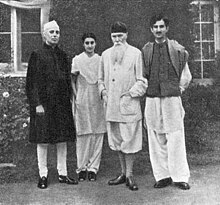
Roerich was in Bharat during World War Two, where he painted Russian epic heroic and saintly themes, including Alexander Nevsky, The Fight of Mstislav and Rededia, and Boris and Gleb.[19]
In 1942, Roerich received Jawaharlal Nehru and his daughter, Indira Gandhi, at his house in Kullu.[ citation needed ] Together they discussed the fate of the new world: "We spoke well-nigh Indian–Russian cultural association [...] it is time to call up most useful and creative co-operation."[20]
Indira Gandhi would afterward recall several days spent together with Roerich's family: "That was a memorable visit to a surprising and gifted family unit where each fellow member was a remarkable figure in himself, with a well-defined range of interests.... Roerich himself stays in my memory. He was a human with extensive noesis and enormous feel, a man with a large heart, deeply influenced past all that he observed."
During the visit, "ideas and thoughts virtually closer co-operation between Republic of india and USSR were expressed. Now, afterward India wins independence, they have got its ain real implementation[ clarification needed ]. And equally you know, there are friendly and mutually-agreement relationships today betwixt both our countries."[21]
In 1942, the American–Russian cultural Association (ARCA) was created in New York. Its active participants were Ernest Hemingway, Rockwell Kent, Charlie Chaplin, Emil Cooper, Serge Koussevitzky, and Valeriy Ivanovich Tereshchenko. Its activity was welcomed by scientists such as Robert Millikan and Arthur Compton.[22]
Roerich had a lengthy correspondence with Henry Wallace, the 1948 Progressive Political party candidate for US president.
Roerich died in Kullu on December 13, 1947.[23]
Cultural legacy [edit]

Altai. Peaks and passes named in honor of the Roerich family unit.

In the 21st century, the Nicholas Roerich Museum in New York Metropolis is a major establishment for Roerich's artistic piece of work. Numerous Roerich societies go along to promote his theosophical teachings worldwide. His paintings can be seen in several museums including the Roerich Department of the Country Museum of Oriental Arts in Moscow; the Roerich Museum at the International Centre of the Roerichs in Moscow; the Russian Country Museum in Petrograd, Russia; a drove in the Tretyakov Gallery in Moscow; a collection in the Art Museum in Novosibirsk, Russia; an important collection in the National Gallery for Foreign Art in Sofia, Bulgaria; a collection in the Fine art Museum in Nizhny Novgorod Russian federation; National Museum of Serbia; the Roerich Hall Estate in Naggar, Republic of india; the Sree Chitra Art Gallery, Thiruvananthapuram, India;[24] in diverse art museums in India; and a pick featuring several of his larger works in The Latvian National Museum of Art.
Roerich's biography and his controversial expeditions to Tibet and Manchuria have been examined recently by a number of authors, including two Russians, Vladimir Rosov and Alexandre Andreyev, two Americans (Andrei Znamenski and John McCannon), and the German Ernst von Waldenfels.[25]
A serial of his studies on the Himalayan Ranges-donated past the artist'due south son (36 works specifically) are even showcased in the Nicholas Roerich Gallery of the Karnataka Chitrakala Parishath Museum based in Bangalore, India. The hypnotic, immersive nature of his works truly absorbs the onlooker, leaving i with a sense of peace and tranquility as i moves with the serial through the gallery.
H. P. Lovecraft refers numerous times to the "strange and disturbing Asian paintings of Nicholas Roerich" in his Antarctic horror story At the Mountains of Madness.
Roerich was awarded Lodge of St. Sava.[26] [27] The minor planet 4426 Roerich in the Solar System was named in honour of Roerich.
In June 2022 during Russian Art Week in London, Roerich'due south Madonna Laboris sold at auction at Bonhams shop for £7,881,250, including the buyer's premium, making information technology the most valuable painting ever sold at a Russian art auction.[28]
Gallery [edit]
-

And We Are Opening the Gates, from the "Sancta" Series
-

And We Are Trying, from the "Sancta" Series
-
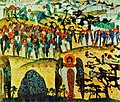
Treasure of angels
-

And We See, from the "Sancta" Series
-

Monhegan, Maine
-
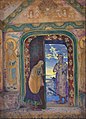
The Messenger
-
Nicolas Roerich. India, Kullu, 1947
Major works [edit]
- Art and archaeology // Art and art industry. SPb., 1898. No. 3; 1899. No. four-5.
- Some ancient Shelonsky fifths and Bezhetsky end. SPb., 31 pages, drawings of the author, 1899.
- Excursion of the Archaeological Constitute in 1899 in connection with the question of the Finnish burials of Leningrad province. SPb., fourteen p., 1900.
- Some aboriginal stains Derevsky and Bezhetsk. SPb., 30 p., 1903.
- In the old days, Petrograd., 1904,xviii p., drawings of the writer.
- Stone historic period on lake piros., SPb., ed. "Russian archaeological society", 1905.
- Collected works. kN. one. M.: publishing house of I. D. Sytin, p. 335, 1914.
- Tales and parables. Pg.: Free art, 1916.
- Violators of Art. London, 1919.
- The Flowers Of Moria. . Berlin: Word, 128 p., Collection of poems. 1921.
- Determined. New York: Corona Mundi, 1922
- Ways Of Approving. New York, Paris, Riga, Harbin: Alatas, 1924
- Altai - Himalayas. (Thoughts on a equus caballus and in a tent) 1923–1926. Ulan Bator Khoto, 1927.
- center of Asia. Southbury (St. Connecticut): Alatas, 1929.
- Flame in Chalice. Series X, Book ane. Songs and Sagas Series. New York: Roerich Museum Printing, 1930.
- Shambhala. New York: F. A. Stokes Co., 1930
- Realm of Lite. Series 9, Volume Ii. Sayings of Eternity Series. New York: Roerich Museum Printing, 1931.
- The Power Of Calorie-free. Southbury: Alatas, New York, 1931.
- Women. Accost on the occasion of the opening of the Association of women, Riga, ed. Almost Roerich, 1931, 15 p., 1 reproduction.
- The Fiery Stronghold. Paris: Globe League Of Civilization, 1932.
- banner of peace. Harbin, Alatyr, 1934.
- Holy Watch. Harbin, Alatyr, 1934.
- A gateway to the Future. Riga: Uguns, 1936.
- Indestructible. Riga: Uguns, 1936.
- Roerich Essays: One hundred essays. В ii т. India, 1937.
- Beautiful Unity. Bombey, 1946.
- Himavat: Diary Leaveves. Allahabad: Kitabistan, 1946.
- Himalayas — Adobe of Light. Bombey: Nalanda Publ, 1947.
- Diary sheets. Vol. ane (1934-1935). M: ICR, 1995.
- Diary sheets. Vol. two (1936-1941). G: ICR, 1995.
- Diary sheets. Vol. 3 (1942-1947). M: ICR, 1996.
See also [edit]
- Imprint of Peace
- List of peace activists
- Morya (Theosophy)
- Russian cosmism
- Roerichism
References [edit]
- ^ Nicholas Roerich: In Search of Shambala by Victoria Klimentieva, стр. 31
- ^ Nicholas Roerich Museum Archived Oct half-dozen, 2022, at the Wayback Machine
- ^ Andrei Znamenski, Red Shambhala: Magic, Prophecy, and Geopolitics in the Heart of Asia, Quest Books (2011), p. 157
- ^ "Nicholas Roerich - Russian ready designer". Retrieved June 14, 2022.
- ^ Nobel Prize Nomination Database
- ^ Julie Besonen, "Visions of a Forgotten Utopian", New York Times, Apr 6, 2022.
- ^ a b Hardiman, Louise; Kozicharow, Nicola (November 13, 2022). Modernism and the Spiritual in Russian Art: New Perspectives. ISBN9781783743414.
- ^ Н. В. Сергеева. Древнерусская традиция в символизме Н.К. Рериха. М.: Международный Центр Рерихов, 2003. ISBN five-86988-080-7. Page 87.
- ^ John McCannon, "Apocalypse and Tranquility: The World State of war I Paintings of Nicholas Roerich," Russian History/Histoire Russe xxx (Fall 2003): 301-21
- ^ Bowlt, John E. (2008). Moscow and Saint petersburg 1900–1920: Fine art, Life and Civilization. New York: The Vendome Press. p. 69. ISBN978-0-86565-191-iii.
- ^ Andreyev, Alexandre (2003). Soviet Russian federation and Tibet: The Debacle of Undercover Diplomacy, 1918-1930s. Brill. p. 294. ISBN9004129529.
- ^ Andreyev, Alexandre (2003). Soviet Russia and Tibet: The Debacle of Secret Diplomacy, 1918-1930s. Brill. p. 295. ISBN9004129529.
- ^ AVPRF, op. 04, op. thirteen, papka 87, d. 50117, one. 13a. Krestinsky to Checherin, Jan two, 1925
- ^ "Andrei Znamenski, "Nicholas Roerich Shambhala Warrior"". .
- ^ Keyhoe, Donald (June 30, 2006). The Flight Saucers Are Real. ISBN9781585092642.
- ^ "The Colorado Engineer". 1954.
- ^ "Roerich Nominated for Peace Award". New York Times. March 3, 1929. Retrieved February 3, 2009.
- ^ "Nomination Database - Peace". Retrieved June 14, 2022.
- ^ Peter Leek (2005). Russian Painting. Parkstone International. pp. 256–. ISBN978-one-78042-975-5 . Retrieved June 23, 2022.
- ^ North. Roerich. Diary Leaves. V. iii. – Moscow, International Eye of the Roerichs. – 1996. – p.39. ISBN 5-86988-056-4
- ^ Interview with Indira Gandhi / Roerich's Empire. (Derzhava Rerikhov) (in Russian). / Collected Articles. – Moscow, International Heart of the Roerichs, Master-Banking company. – 2004. – p.65. ISBN 5-86988-148-X
- ^ Ruth Abrams Drayer (2005). Nicholas and Helena Roerich: The Spiritual Journey of Ii Slap-up Artists and Peacemakers. Quest Books. pp. 330–. ISBN978-0-8356-0843-5 . Retrieved June 23, 2022.
- ^ Madhukar, J. (October 20, 2022). "Remembering Roerich". 'The Bangalore Mirror'. Retrieved Jan 29, 2022.
- ^ "Dust throws a blanket over prized paintings". .
- ^ Nicholas Roerich: the Messenger of Zvenigorod (vol. 1: The Cracking Plan, vol. 2: The New Country) (2002–2004) [summary of the books in English at "Archived copy". Archived from the original on November x, 2022. Retrieved August 9, 2022.
{{cite spider web}}: CS1 maint: archived copy as title (link)]; Alexandre Andreyev, Gimalaiski mif i ego tvotry [Himalayan Myth and its Makers] (St. Petersburg: St. Petersburg University Press, 2004) [in Russian]; Andrei Znamenski, Red Shambhala: Magic, Prophesy, and Geopolitics in the Middle of Asia (Quest Books, 2022) [see an excerpt from the book at http://www.trimondi.de/EN/Red_Shambhala.htm]; John McCannon, "Searching for Shambhala: The Mystical Fine art and Epic Journeys of Nikolai Roerich," Russian Life (January–February 2001); John McCannon, "Past the Shores of White Waters: The Altai and Its Place in the Spiritual Geopolitics of Nicholas Roerich," Sibirica: Journal of Siberian Studies (October 2002) [ane]; Ernst von Waldenfels, Nicholas Roerich: Kunst, Macht und Okkultismus (Osburg, 2022) - ^ Radulovic, Nemanja. "Rerihov pokret u Kraljevini Jugoslaviji". Godišnjak Katedre za srpsku književnost sa južnoslovenskim književnostima, Eleven, 2022.
- ^ "Vreme - Kultura i politika: Selidba trajne pozajmice". www.vreme.com . Retrieved July eleven, 2022.
- ^ "Bonhams : Nikolai Konstantinovich Roerich (Russian, 1874-1947) Madonna Laboris". Retrieved June fourteen, 2022.
External links [edit]
- International Centre of the Roerichs
- International Roerich Memorial Trust (India)
- Nicholas Roerich Museum (New York)
- Estonian Roerich Society
- Roerich-movement on the Internet (in Russian)
- Paintings Gallery
- Nicholas Roerich Manor Museum in Izvara
- Roerich Family [ dead link ]
- Find A Grave
- Catalogue of Nicholas Roerich`southward works from the drove of Gorlovka Art Museum
- Nicholas Roerich Papers, J Murrey Atkins Library, UNC Charlotte
- Nicholas Roerich Lexicon
- Gallery of Russian Thinkers on Nicholas Roerich, ISFP Gallery of Russian Thinkers
- Nikolay and Svyatoslav Roerich

Source: https://en.wikipedia.org/wiki/Nicholas_Roerich
Posted by: monroewhia2001.blogspot.com
0 Response to "Who Repairs Antique Radios Near 18944"
Post a Comment